05 December 2023

4 Keys to Italian Genealogy

I've learned so much by spending countless hours immersed in Italian vital records. If you're new to Italian genealogy research, I can save you those countless hours.

Here are the 4 keys to help you build your Italian family tree.

Here's your crash course in Italian genealogy documents. Use these 4 keys to build your family tree.

1. Location and Mobility

To find Italian vital records, you must know where your people came from. Not all records are searchable in one convenient form. And without the town name, you can't be sure you've found your person or someone with the same name. Records are stored by town name and held in the provincial capital's archives. The town name is your first hurdle. Read "4 Key Places to Discover Your Ancestor's Hometown."

Until the 1890s, most Italians stayed in or near their hometown for generations. It isn't as if a man could meet a woman who lived hours away and marry her. You must expect that your ancestral couples lived in the same town or neighboring towns. There were no highways and travel wasn't easy.

When a couple from different towns married, they were likely to marry in the woman's town but live in the man's town. A man could inherit property, so they lived in the man's home—which may include other members of his family.

Tip: If your couple married in Italy, expect them to have been born in the same town or neighboring towns.

2. Language Is NOT a Barrier

There's no reason on earth to let the Italian language stop you from reading a vital record. The documents follow standard patterns. And you don't need to translate every single word. What you want to find are:

  1. Names don't need translation. They are exactly what you see in the document. There's no reason you can't spot the name you're looking for in a document.
    • If a last name is hard to decipher, type what you think you see into the Cognome box on the Cognomix website. As you type, you'll see suggestions of actual names. Once you click Cerca (Search), you'll see where you can find that name in Italy. https://www.cognomix.it/mappe-dei-cognomi-italiani
    • Another option: Type a last name into Ancestry and FamilySearch to see suggestions.
  2. Place names (both town names and street names) don't need translation.
    • If you found your document on a genealogy website, the website should tell you the town name.
    • If you received the document another way, the town name is on the document. Look close to the top of the document, often after the words Comune di (town of).
    • If the comune name is hard to read, use this alphabetical list of Italian towns and try to match what you see. http://en.comuni-italiani.it/alfa
    • Street names may no longer exist in your ancestral town. But if you want to have a look, use Bing Maps rather than Google Maps. It has more street names than Google in Italian towns. https://www.bing.com/maps
    • Some street names begin with the word Contrada. A contrada is more of a neighborhood name. It can be a large area with only one road running through it. That road name will usually be the Contrada name. These are easiest to find on the map because they're well outside the town center.
  3. Dates do need translation, but there is one terrific resource to help you out. The FamilySearch Wiki has month names, numbers, and other key genealogical word translations. https://www.familysearch.org/en/wiki/Italian_Genealogical_Word_List
    • On most Italian vital records, you'll see numbers written out in longhand, not numerals. That includes years. With practice, seeing mille ottocento ventiquattro instead of 1824 is no problem.
    • Vital records begin with the date someone wrote the document. That means the event may have happened earlier. On a birth record, look further down for the (often pre-printed) words nel giorno (on the day) and del mese di (of the month of). If you see nel giorno sette del mese di Gennaro, you'll know the person was born/died on the 7th day of January. (Check the FamilySearch Wiki linked above for numbers and months.)
    • Birth records often have a separate column for the baptism. This may include a church or parish name. You can look up a church name by location using this website: https://italia.indettaglio.it/eng/parrocchie/parrocchie.html. You may get the street address of the church, too.
      • The baptism column can be confusing because it can have up to 3 dates. Look for the earliest date, and that's the baptism. The format: On this date(1) the church notes that on this date(2) we recorded that on this date(3) we baptized this baby. Wacky, yes, but look for the earliest date.
    • Marriage records often have a separate column, too. In the smaller column you'll find the date and place of the church wedding. It's often later than the date at the top of the main column. I record the main column's date as the marriage license. On this date, the couple was married in the civil sense. Afterward, they married in the church.

3. Where to Find the Facts

We've just explored the different types of names, dates, and places you'll find on vital records. Now let's dive deeper so you know exactly what to expect to find. The standard forms used in your ancestral towns will change over time, but the basics are the same. (In my towns, the 1866–1873 documents are all in longhand. That's why it's important to know what to expect.)

  • Birth records. The basic format is:
    • On this date, before the mayor (look for the word Sindaco) of this town, appeared (look for the word comparso) FATHER of baby (and maybe his father's name), age, profession, residence (look for the word domiciliato) to present a baby (bambino is a boy, bambina is a girl).
    • Next, sometimes written entirely in longhand, you'll see MOTHER of baby, age, profession. The word moglie (wife) tells you that the father and mother are legally married.
    • Next is the date of birth (nel giorno _____ del mese di _____), followed by the baby's name.
    • Look for a baptism date in a separate column or sometimes written briefly in the margin.
  • Marriage records. These begin the same way as a birth record, with the date, mayor, and town. Then comes the important stuff:
    • After the word comparsi, look for GROOM's name, age, place of birth (nato in), profession, and residence.
    • The groom's parents come after the words figlio di (son of). You'll find his father's name, occupation, and residence, and if he's dead, you'll see the word fu (was) before his name. Then you'll find his mother's name, sometimes her profession, and her residence. If you're very lucky, you'll get the parents ages and maybe their dates of death.
    • Next comes the BRIDE whose name comes after the word e (and). Look for her age, place of birth, and residence.
    • After the words figlia di (daughter of), look for her parents in the same format as the groom's parents above.
    • Look for the date and place of the church wedding in a separate column.
  • Death records. After the date of the document, the mayor's name, and the town name, death records usually list 2 witnesses. You can look for familiar last names or relationship words (avo=grandfather, zio=uncle), but there may be no relationship. The important facts begin after the witness information.
    • Look for the words che nel giorno (that on the day). What follows is the day and month of death.
    • If it says é morto(a) nel(la) casa propria, you know this person died in their own home (casa propria). Use these words as a clue to the person's gender if you're unsure. Morto nel casa propria means it's a male. Morta nella casa propria means it's a female.
    • If you don't see the words casa propria, they died somewhere else—like in someone else's house. Don't let that extra name of the homeowner confuse you. If it starts with nel casa di (in the house of) then the following name should be the homeowner, followed by the deceased's name.
    • Look for the deceased's name written in longhand. It may also say they were the husband (marito) or wife (moglie) of the following name.
    • Next look for the deceased's age (di anni _____), place of birth (nato di _____), profession, residence, and their father and mother's names, professions, and residence.

For diagrams showing where to find the facts on Italian vital records, see:

Unless there's a handwritten paragraph after that, then you've found the facts you need. Sometimes an extra paragraph will explain important facts such as:

  • The father didn't report the birth because he was ill, out of the country, or he died on this date.
  • The child in this birth record married this person on this date. This is a treasure written in some empty space on a birth record.
  • The baby's birth was legitimized by the marriage of its parents on this later date.
  • This man died leaving several minor children, and here are their names and ages.

If you see a long handwritten paragraph on your document, look for keywords like:

  • matrimonio (marriage)
  • morto (death)
  • figli minori (minor children)
  • ammalato (ill)
  • lontano dal paese (far from the country)

Use the FamilySearch Italian Genealogical Word List and Google Translate to see if you've found useful information or standard boilerplate.

4. Naming Conventions

Different cultures have different standards for what to name the baby. Keep in mind, these could be more guidelines than rules. Many of my own ancestors completely ignored the naming conventions. In general:

  • The first male is named after his paternal grandfather.
  • The second male is named after his maternal grandfather.
  • The first female is named after her paternal grandmother.
  • The second female is named after her maternal grandmother.

But here are more naming conventions to look for:

  • If a baby is born after their father dies, the baby is named after the father. A baby girl may receive a female version of her father's name, such as Francesca if her father was Francesco.
  • Say a person becomes a widow and then remarries. Their next child is named after the deceased spouse. This is a good way to confirm that you've found the remarriage of a particular man or woman.
  • When a child dies, the parents usually give the next child of the same sex the same name as the deceased child. You may find birth records for 2, 3, or 4 siblings with the same exact name. If you do, then you can assume each one died before the same-named sibling was born. This comes in handy if death records are not available.

Tip: A set of marriage documents may use the birth record of a same-named deceased sibling. This is just human error.

In my towns, I've seen families wait until baby-boy #4 before using the paternal grandfather's name. And many families never get to the 4th grandparent's name. This may be a regional practice since all my ancestors came from neighboring towns. Maybe the naming rules were less strict there. Keep an open mind and don't rule someone out because they don't have the name you'd expect.

When you find a marriage record and the groom came from another town, search that town for their kids. Any time you learn your person's parents' names, you can expand your search. You can search for the previous generation's birth, marriage, and death records, if the years are available. Read "How I Tracked Down My 4th Great Grandmother's Parents."

That's the beauty of Italian vital records. Each one you find for someone in your family tree can lead to more and more generations. You now have the keys. As long as records are available for your towns, there's no stopping you.

28 November 2023

4 Rules for the Names in Your Family Tree

I've been on a rampage this year, adding thousands of people to my family tree. Once I discovered that everyone in my ancestral hometowns had a connection, I set out to prove it. Each town's vital records (1809–1942 with gaps) added at least 20,000 documented people to my family tree. (Discover the Lessons Learned from My One Place Study.)

The documents come from Italy's Antenati website. Thank you, Italy! Find out how to harvest the Antenati website for your Italian family tree.

During this journey I've learned a lot about the first and last names in my towns. I realized that I've developed 4 rules that make it easier to manage my 23,073 families. (That number comes from the powerful and free Family Tree Analyzer and my latest GEDCOM file.)

Here's a look at 4 naming rules to use in your own family tree.

Follow these simple naming rules to avoid errors and confusion.

1. Use Birth Names

The best way to record any person in your family tree is by their birth name. If you have their birth or baptism record, then you know what name their parents chose. We all knew my grandmother as Mary Leone, but Leone is her husband's name, not hers. And Mary is an Americanization of her given name—which is different than the name she claimed was hers! Her birth record calls her Maria Carmina Sarracino, so that is the name I recorded in my family tree.

Why record a woman in your family tree with her husband's last name when you know her father's last name? When you view her, it's plain to see who she married.

It's important to use original last names so all the siblings in a family unit show the same name. Anything else looks like a research blunder.

2. Use Original Spelling

I have examples from my ancestral hometowns where the spelling of a last name changed over time. The name:

  • Esci became Iesce
  • diRuccia became Ruccia
  • Cifaldi became Gifaldi
  • Italian names ending in an o later ended in an i.

Since my family tree covers many generations, I use the original last name for continuity. Then, since the name may change over time, I note this in an easy-to-find place. In Family Tree Maker, I use the description field for a person's birth fact to note alternative spellings. (Don't overlook this important feature to leave research breadcrumbs in your family tree.)

Many times a person will use a first name variation during their life. That causes problems when you're searching for the children of a particular couple. If the father was born Domenico but goes by Giandomenico as an adult, you may overlook his children.

In these cases I make 2 kinds of notes in that birth fact description field:

  1. For the father, Domenico, I'll type "aka Giandomenico"
  2. For their child, I'll type that their "father is called Giandomenico on their birth record"

These notes have bailed me out time and again when I find a vital record that doesn't seem to fit.

Because I researched all the town's records that I know people named Gifaldi were the descendants of people named Cifaldi. To make sure I found every family member, I changed my inventory to show only the original spelling.

3. Record But Don't Use Name Variations

On a similar note, if someone's vital record uses a different spelling of their name, I'll note that fact, too. I record the Esci children whose vital records say Esce, Iesce, or Iesci as Esci. But I add a note to the description field saying, "Her last name is Iesce on her birth record."

This happens with first names, too. A woman born as Concetta is Maria Concetta on her death record. During review, that may look like I made a mistake. So I put a note in the description field of the death fact saying, "She is called Maria Concetta on her death record." This assures me that I did my careful research, and there is a discrepancy in the documents.

I leave her name as Concetta, but understand that she may be Maria Concetta on the birth records of her children. And I'll note that for each child.

4. Expand Searches to Include Name Variations

You must take all the name variations into account when you're searching for records. I've created my own extraordinary database of the vital records of my ancestral hometowns. I've named each record image with the subject's name and their father's first name. That way, I can easily search for all the children of a particular man.

But what happens when that man's first name has variations? It's simple. You have to search for all the logical variations. A man named Giambattista at birth may be listed on his children's birth records as:

  • Giambattista
  • Gianbattista
  • Giovambattista
  • Giovanbattista
  • Giovanni Battista
  • Giovanni
  • Battista

When a father has a compound name that has variations, I search for all possibilities. In this case, I can search for children with the right last name and a father whose first name begins with "Gi." (I'll search for Battista alone as a second search.) Then I can view the results, checking for Giambattista's wife's name, their ages, etc.

Remember these 4 key points.

One huge benefit to my quest to get entire towns into my family tree is name familiarity. I can:

  • spot a spelling variation
  • decipher the worst handwriting, and
  • identify an out-of-towner in an instant.

That's because I know all the names in my towns. I know their original spellings and their common variations.

How familiar are you with the names from your ancestral hometowns? Are your naming styles causing confusion?

21 November 2023

4 Best Ways to Learn from Your DNA Matches

I've had tons of success identifying and learning important facts from my DNA matches. Here are 4 articles featuring the most successful methods to use.

I left one article off this list: "Use Color-Coding to Solve Mystery DNA Matches." This otherwise powerful technique doesn't work with endogamous families like mine. But it's well worth a look if your tree is not endogamous.

Endogamy is the practice of marrying within your own culture, ethnic group, town, etc., for centuries. This "muddies" your results. Different branches of your family tree will have very similar DNA.

These 4 articles represent the best ways to work with your DNA matches to fortify your family tree.

Are you getting all you can from your DNA matches? These 4 methods can really help.

1. 3 Key Steps to Identify a DNA Match

This article explains how to figure out your mystery DNA match by:

  • Looking at your shared DNA matches.
  • Searching their trees for familiar last names. (Notice I said familiar names, not your name.)
  • Doing their research for them (but it's actually for you).

It's a method you can repeat over and over with positive results.

2. Digging Into a DNA Match's Family Tree

This article is a practical case study that expands on the article above. Don't waste your time on matches with no family tree or a useless family tree. Find matches with at least a couple of generations to their trees and search for a solid entry point. Find out how you can do this with your DNA matches.

3. Why Care About Your DNA Matches?

Your very distant DNA matches can still add value to your family tree. You may not know what became of your 2nd great grandfather's brother, but your distant cousin may. Here's how you can use your DNA matches to find lost relatives and missing families.

4. How to Use DNA Matches to Go Beyond Vital Records

I have a completely insane family tree—and not for the reason you may be thinking. My ancestors came from isolated towns, intermarrying like crazy. That means I can find some connection to everyone from each town. I'm using the Antenati website to piece together my connection to everyone from my towns. I have 72,000 people right now, and I'm far from done.

The only problem is, lots of documents are not available. In my towns, there are no death or marriage records from 1861–1930, births end in 1915, and there's nothing after 1942. The great value of DNA matches is that their personal knowledge can bridge that document gap. I especially love it when their trees can prove that two people already in my tree married one another. I had no way to know that, but now I do!

Follow this simple method and harvest the relationships you never knew existed.

I've had so much success with the Antenati website that it'd take pre-1809 church records for me to go any further. Now and then I choose a few more DNA matches to explore. The hope is that someday I'll find a distant cousin who has already seen those old church records!

A 15% discount for readers of Fortify Your Family Tree!

14 November 2023

Top 5 Favorite Genealogy Projects

The Fortify Your Family Tree blog focuses on constructive ways to improve your family tree. These 5 genealogy projects have gotten the most attention from you, the readers.

Take a fresh look at these 5 genealogy projects and see which ones are right for you at this point in your research.

Take another look at the 5 most popular genealogy projects from Fortify Your Family Tree.

1. 3 Things to Do with Ahnentafel Numbers

The Ahnentafel numbering system is an excellent way to see which ancestors you've found and which ones you're missing. This article contains a free downloadable chart that I use for tracking my ancestors. I can see, for instance, that I'm missing one of my 3rd great grandparents, and I've found 5 of my 9th great grandparents.

2. How to Create a 'Book of Life' for Your Relatives

I have a cousin who's very interested in our family history. So, for an milestone birthday, I made her a 'Book of Life' like the ones you see on the PBS program "Finding Your Roots." It's easy to do and gets a tremendous reaction. This article shows you exactly how you can create a book of life.

3. How to Share Your Family Tree Research with Relatives

I was reluctant to share my family tree with all the cousins because it wasn't fully researched yet. But one cousin convinced me to do so. I distributed 40 large posters to the heads of all the families, and everyone loved it. This article offers a few creative ways to share your research with your family.

4. 7 Days to a Better Family Tree

Here's an explanation of 7 different ways you can greatly improve your family tree. I suggest you spend a nice long session on each item. You may not complete them in 7 consecutive days, but that's fine. In the end, your research will be more complete and your family tree will have more consistency.

5. 5 Steps to Writing Your Ancestor's Life Story

Sometimes we don't try to tackle certain projects because we expect they'll be too tough. This article breaks down the process of writing your ancestor's life story into 5 steps. Taken one at a time, they're not the least bit overwhelming. Give it a try!

Thank you for visiting this blog and spending your valuable time. I reap the benefits of applying skills I learned at work to my family tree. And now that I'm retired, this weekly blog *is* my job.

07 November 2023

How to Get Useful Answers to Your Genealogy Questions

I'm a long-time user of the Microsoft Bing search engine rather than Google. Bing is promoting its AI Chat feature to give you an easy-to-read summary of your search results.

I decided to enter some genealogy questions into the chatbot (now called Microsoft Copilot). It summarizes it answers from several sources, which it cites so you can dive deeper into the answers.

Question 1

First I asked a question that I know is a mystery to many researchers of Italian family history. I asked, "How long are bodies kept buried in an Italian cemetery?" Many people expect to go to Italy and find all their ancestors in the cemetery of their hometown. They're disappointed when they get there.

The chatbot answered:

In Italy, the length of time a body is kept buried in a cemetery depends on the type of burial. If the deceased is buried in an individual tomb, the plot can be leased for between 10 and 50 years, after which the lease can be renewed. If the deceased is buried in a communal burial ground, the remains are exhumed after only ten years. If the municipality needs space, after 20 years from the burial, the corpse can be exhumed, and the remains are put in a smaller box and then into a recess in the wall or in the family tomb, if some member of the family requests it; otherwise, the remains are put in the ossuary.

Follow-up question: "What is an ossuary?"

Answer: An ossuary is a container or room in which the bones of dead people are placed. They are frequently used where burial space is scarce. A body is first buried in a temporary grave, then after some years the skeletal remains are removed and placed in an ossuary. The word “ossuary” comes from the Latin word “ossuarium,” which means “a container for bones”.

I learned about this on my trips to my ancestral hometowns. The cemetery keeps a small footprint because they continually reduce each body's space. And the ossuary room in my maternal grandfather's hometown is quite a sight to see!

Ask detailed genealogy questions, and a chatbot gives you the results in a conversational style.

Question 2

Next I asked, "What are the child-naming customs in different countries?" The answer was long and didn't cover any countries I can use. It's better to make your question more specific. So I asked, "What are the child-naming customs in Latin countries?"

The chatbot answered:

Naming a child is a special moment for parents, and it can be influenced by various factors such as religion, culture, and family traditions. Here are some examples of child-naming customs from Latin countries:

  • Argentina: In Argentina, it is common for children to take their father’s surname as their last name. However, it is not uncommon for children to have both their mother’s and father’s surnames.
  • Brazil: In Brazil, it is common for children to have two given names, with the first name being the most important. The second name is often the mother’s maiden name or the father’s surname.
  • Chile: In Chile, children are given two surnames, the father’s surname followed by the mother’s surname. It is also common for children to have two given names.
  • Colombia: In Colombia, children are given two surnames, the father’s surname followed by the mother’s surname. It is also common for children to have two given names.
  • Mexico: In Mexico, children are given two surnames, the father’s surname followed by the mother’s surname. It is also common for children to have two given names.
  • Peru: In Peru, children are given two surnames, the father’s surname followed by the mother’s surname. It is also common for children to have two given names.

The part I wanted to confirm, because I was never sure, is that double last names from these countries are typically the father's last name then the mother's last name.

Question 3

A friend mentioned that a woman in her family tree became a widow, and then married her father-in-law. I wondered if that made their child the man's daughter and granddaughter, but not by blood, of course.

So I asked the chatbot a related question, "Are first cousins allowed to marry?"

In the United States, 19 states say, "Sure! Go ahead," while a few make it a criminal offense. Since I deal in Italian research, I was more interested in the second part of the chatbot's answer:

In general, the Catholic Church does not allow first cousins to marry. According to canon 1091.2, marriages are invalid up to and including the fourth degree. First cousins, therefore, cannot marry in the Church.

Digging a little deeper, I found that "the fourth degree" refers to first cousins. Now I'm wondering if I have anyone in my tree who somehow got around that rule.

Then, for the sake of this article, I asked, "Is chat bot one word or two?" It's one: chatbot.

Your Turn

I intend to keep this method in mind for future genealogy questions. What questions would you like to ask the chatbot? Do you have cultural questions about your ancestors' countries? Do you suspect an illness swept through their town during certain years? Are you curious about their marriage customs?

Leave a comment with questions you found helpful to your understanding of the people in your family tree.

31 October 2023

Tour Your Ancestral Hometowns with YouTube

I haven't visited my ancestral hometowns since 2018, and I'm really starting to miss them. I'd love to walk the streets again, linger longer, and talk to more of the villagers.

Then a great idea fell into my lap. I wanted to find some information about a town I haven't visited yet. My 3rd great grandmother Rufina's hometown is Apice, and it's now a ghost town. An earthquake in the 1980s made the whole town too dangerous to live in. They call the deserted part of town Apice Vecchio (vecchio means old). Today everyone lives nearby in the very modern-looking Apice Nuovo (nuovo means new).

Among my search results were articles and videos about the ghost town. I saw a suggested video posted by another of my ancestral hometowns: Pesco Sannita.

What's this? My great grandmother's town has a YouTube channel? I watched an English-subtitled video about agriculture in my great grandmother's hometown. I'll be sure to look for the vineyards and olive tree groves on my next visit.

I watched another video about the Fiume Tammaro. I found this river (fiume) mentioned on 6 Pesco Sannita death records from the 1840s and 1850s. Young boys kept drowning there. Seeing the video, it seems too shallow and slow-moving to have taken the boys' lives. Even more surprising is that some women still wash their laundry in the river.

The town's YouTube videos include:

  • beautiful fly-overs filmed by drones
  • cultural events
  • demonstrations by a local chef
  • a look inside their restaurants, and more.

What else can I find from my ancestral hometowns? Searching for my grandfather's town of Baselice, I found:

  • more drone fly-overs
  • promotional videos for the town
  • a description of a public works beautification project.

I'm a big fan of the drone fly-over videos (many created by Raffaele Pilla). I spotted my grandfather's house in one of them!

You can fly over, walk through, and learn the culture of your ancestral hometowns right on YouTube.

For my other grandfather's town, Colle Sannita, I found messages from the mayor and town council meetings. For my great grandparents hometown of Sant'Angelo a Cupolo, I found a fly-over video and a first-person view of a foot race through town. Even the real estate videos are great because they give me a view inside the homes. That's something I can't see while walking through my towns.

I also watched video tours of the city of Benevento. It's the center of all my ancestral hometowns, and I have 2 cousins who own restaurants there. I've been to Benevento 3 times and still haven't seen all the sights.

Search for videos from your ancestral hometowns by typing the name of the town in the YouTube search box. Be sure to use the correct in-country spelling of the town name. Pay attention to who is posting the videos you like. They may have more videos for you in their collections.

Be sure to hover over the video and click CC (closed captioning) to see subtitles. If they aren't in English, click the gear next to CC, click Subtitles, Auto-Generate, and choose your language. The translations may not have the best quality, so keep an open mind. If you can't click the CC, the video may have no spoken words.

While I was at it, I searched YouTube for my current hometown in New York. I found some interesting videos about the town's railroad history. Then I found videos about the little town of Hornellsville, NY, where my grandmother was born. If you haven't used YouTube to give your genealogy research some context, you should give it a try.

24 October 2023

Make an Easy Ancestral Map for the Cousins

I love when I'm at a family gathering and I hear one of my cousins say, "Ask DiAnn. She knows all about our family history." At a recent get-together, 2 cousins approached me separately, asking for the same basic thing.

"We need a visual," my 1st cousin said. "Give us a map that shows which ancestors were born where."

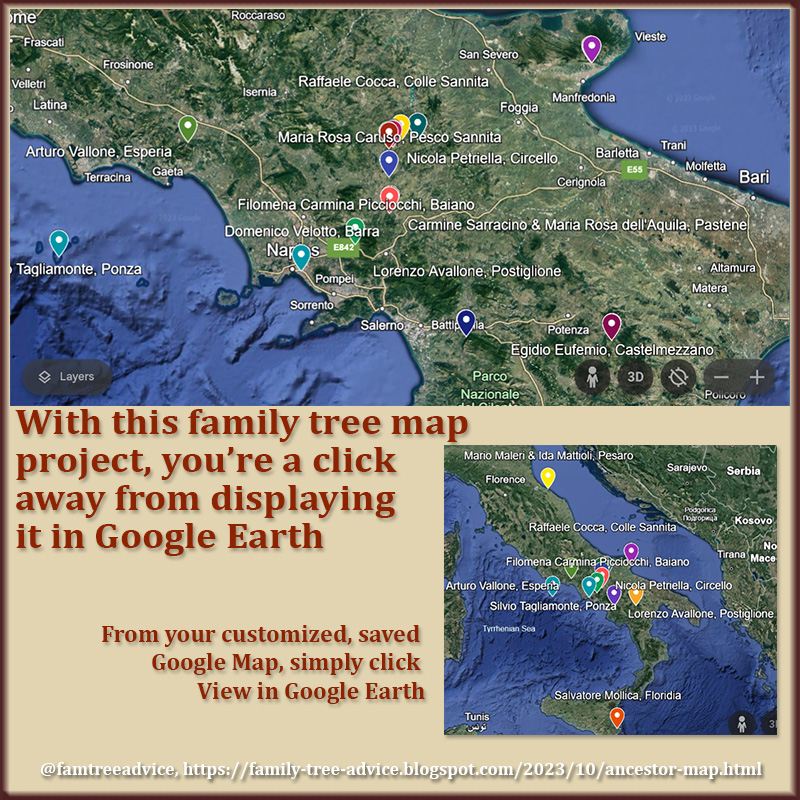
That sent my mind racing. This sounds like a great gift idea for any genealogist to make. I'd already plotted my direct ancestors on a map. The result was a highly concentrated cluster of pinpoints in a very small section of Southern Italy. My homogeneity is like having all your ancestors come from one county in America…at least as far back as the 1600s.

It's easy to create this highly customized map to show all your cousins their ancestral roots.

While my ancestral map is exactly the same as my brother's, it's only partly the same as any of my cousins'. However, I do know that most of the aunts, uncles, and cousins who aren't my blood relatives came from the same general area. "They stayed within their tribe," as my godmother Rae put it.

Other than one town in Sicily and another up north, I can cover all my own and my cousins' ancestors in one thin horizontal slice of Italy. It begins south of Rome and ends south of Naples.

How to Create Your Family's Ancestral Map

Part One of Two: Create a list of immigrant ancestors and their hometowns. If you've already researched the immediate families of your closest cousins, you should have all these names and places handy in your family tree. Here's how to start:

  • Make a list with yourself and your siblings on line 1.
  • Add a line for each set of 1st cousin siblings.
  • Add a line for each set of 2nd cousin siblings.

I could include some of my 3rd cousins, but the map would get very busy.

Let me explain that the people I call "the cousins" fall into 2 main groups, both somewhat small:

  1. On Dad's side, I have only a brother-sister pair of 1st cousins. We've had a close relationship our whole lives. There are 2nd cousins, but since they're in Ohio, I've never known them.
  2. On Mom's side, we all descend from 5 Bronx-born siblings whose parents came from Italy. It's this clan that has been a constant presence throughout my life. I have three 1st cousins and 14 2nd cousins in my generation. We're compact because no one had more than 4 kids and some had only one.

For my list, I started with myself, then listed the kids of each of Mom's 1st cousins as a group. (Trust me, this is an efficient way to do it.) I added a last line for my paternal 1st cousins. Then I spelled out the immigrant ancestors' names and towns.

Here's my list of the whole family's immigrant ancestors and their hometowns. (I shrunk the text because it's a long list.)

  • Me:
    • Adamo Leone from Baselice
    • Giovanni Sarracino and Maria Rosa Saviano from Pastene
    • Pietro Iamarino from Colle Sannita
    • Maria Rosa Caruso from Pesco Sannita
    • Pasquale Iamarino from Colle Sannita
  • S's kids:
    • shared Adamo Leone from Baselice
    • shared Giovanni Sarracino and Maria Rosa Saviano from Pastene
    • Nicola Petriella from Circello
    • Raffaele Cocca from Colle Sannita
    • Nicolina Barone from Circello
  • E's kids:
    • shared Giovanni Sarracino and Maria Rosa Saviano from Pastene
    • Arturo Vallone from Esperia
    • Salvatore Mollica from Floridia in Sicily
    • Domenico Velotto from Barra in Naples
    • Filomena Carmina Picciocchi from Baiano
  • L's kids:
    • shared Giovanni Sarracino and Maria Rosa Saviano from Pastene
    • shared Arturo Vallone from Esperia
    • Lorenzo Avallone and Maria Cristina Romagnano from Postiglione
  • A's kids:
    • shared Giovanni Sarracino and Maria Rosa Saviano from Pastene
    • Egidio Eufemio and Antoinette Trevignia from Castelmezzano
  • R's kids:
    • shared Giovanni Sarracino and Maria Rosa Saviano from Pastene
    • Carmine Sarracino and Maria Rosa dell'Aquila from Pastene
    • father's side from Germany and Ireland. Not in scope for this project.
  • J's kids:
    • shared Giovanni Sarracino and Maria Rosa Saviano from Pastene
    • Matteo Rignanese and Angela Maria Frattaruolo from Monte Sant'Angelo
  • B's kids:
    • shared Giovanni Sarracino and Maria Rosa Saviano from Pastene
    • Mario Maleri and Ida Mattioli from Pesaro
  • My paternal 1st cousins:
    • shared Pietro Iamarino from Colle Sannita
    • shared Maria Rosa Caruso from Pesco Sannita
    • shared Pasquale Iamarino from Colle Sannita
    • Silvio Tagliamonte from Ponza

Whew! That's what years of research can do for you.

Part Two of Two. Begin plotting your map. You can use Google Maps for this project, but you'll probably need to have or create a free Google account to save it.

  • Go to google.com/maps and clicked Saved in the left column. This should work even if you've never saved anything.
  • Click Maps near the top-right, then click CREATE MAP at the bottom.
  • To give your map a name, like Cousins' Roots Map, click the words Untitled Map. I also renamed the Untitled Layer to Ancestors. You could choose to create different layers for different sets of cousins.
  • Consulting your list, search for an immigrant ancestor's hometown on the map.
  • When you find a town, hover over its name in the left-side control panel and click the + sign that appears. This opens up a detail box. At the bottom of the box, look for and click the pencil so you can make an edit. I'm changing my saved places from just the place name to Ancestor's Name, Place Name. For instance, Pietro Iamarino, Colle Sannita. Click Save when you're done.
Go through these 4 steps to begin creating your unique ancestral family tree map.

Open up the Base map section at the bottom of the control panel. Try out different map styles to see which you like best. I chose the Light Landmass map to help my map pins and labels stand out. But I switched back to the first option when I needed to see street names or more detail.

Now click the words Uniform style in the control panel. Change Set labels from description to name. This puts your Ancestor Name, Place Name labels on the map.

When I clicked Uniform style again, I chose to Group place by name. Suddenly all my map pins had different colors, which is very nice.

Since I have multiple people from the same town, I couldn't see some of their names. Only the last one I entered in a town showed. To get around this problem, I chose different locations in town for my people who came from one town. I can click a different part of town for each person and add them there. It took me a couple of tries to make sure the names were far enough apart not to overlap one another. I also combined married couples from the same small town into one pin.

When you're happy with your map, click Share in the control panel. Be sure to click Anyone with this link can view. At the bottom you'll find a link you can copy and give to your cousins.

Click around to find different options to customize your ancestral family tree map.

See what your cousins think, but you can make the map labels simpler by using the person's name only—not their town. The map itself will tell you their town. Also, if it works for you, you could use only a last name as the label.

I like that this map is interactive. You can zoom in and out and get a good idea how close or far apart your ancestors lived. My cousins want us to take a group trip to the places where our map pins are so densely clustered.

Wouldn't it be nice to print this map to a PDF file and give it to your cousins? You can! Here's how:

  • Zoom in or out on the map to make all your pins visible.
  • Click the 3 vertical dots to the right of your map name in the control panel and choose Print map.
  • Select PDF and click Print. Play around with how much of a zoom gives you the best results.

The resulting PDF includes all the map pins you created in a list on the left, and the map on the right. If you create a separate layer for each group of cousins, you can easily print a unique gift for each set of cousins. Have fun!

Bonus! At the last second, I discovered you're a click away from exploring your map in the intensity of Google Earth. Click the 3 vertical dots to the right of your map name in the control panel and choose View in Google Earth.

17 October 2023

4 Must-Have Resources for Your Italian Family Tree

Once in a while you'll find a document for your family tree with a new last name or place name you can't quite read. When that happens to me, I know exactly which free websites to go to.

Here are the 4 Italian genealogy bookmarks I use to solve a mysterious last name or place name. Two can help you decipher a last name and two can help you find a place on the map.

One quick note about using these websites. You'll usually see a pop-up ad before you can proceed. To dismiss the ad, click the button that says "Chiudi" (Close).

1. Map of Italian Last Names

Use the "Cognomix" website at https://www.cognomix.it/mappe-dei-cognomi-italiani to confirm the spelling of a last name. The site's main purpose is to show you all the places in Italy where you'll find any given last name.

That's very handy when you want to see if a last name is still found in a certain town. But another important use of the site is to check the spelling of a last name. I have one ancestor who came from a different town, but raised her family and died in one of my ancestral hometowns. Her last name was hard to decipher. I found it on more than one document, but that didn't help me. It looked a little different each time.

To figure out the right spelling, I went to the Cognomix site to try out different spellings. To use the site, scroll down a bit until you see a black bar that says "Mappe dei cognomi italiani." Beneath the bar is a blank box with the heading "Cognome," Italian for surname or last name. Type a name in the box and click the "Cerca" (Search) button.

First you'll see a map of Italy showing you how many families have that name and in which regions. Click any region to see how many families have that name in different provinces. Click any province to see the number of families with that name in different towns.

But—before you click the Cerca button, see if any suggested names pop up below the box where you're typing. If there are no suggestions, you're likely to find no results when you click Cerca. And you may find a better suggestion.

Can't read that Italian last name? Bookmark these free websites and solve the problem.

I used Cognomix to figure out the ancestor whose name was new to me. The first writing of her name looked like Gajdia. (Note that sometimes in Italian words you'll see a j instead of an i.) When I type Gajdia in the Cognomix box, there are no suggestions. When I change it to Gaidia, there are still no suggestions. But one time, her name looked like Gasdia. When I type that into the box, Gasdia comes up as a suggestion. Now I can click Cerca to see where the name Gasdia comes from. I expect her to come from a town very close to where she lived after her marriage.

I discovered this uncommon name comes mostly from the Campania and Campobasso regions. That works for my family. By clicking a region and then a province, I can narrow down her likely place of birth. There's a good chance she came from either the city of Campobasso or the town of Fragneto Monforte.

My ancestor was born too early to find in vital records. If she'd been born later, I could try to track her records down in one of these two towns.

2. The Italian White Pages

The Pagine Bianche at https://www.paginebianche.it shows you exactly where to find a last name in Italy today. Look for a search area front and center on the website. Click the "Privati" button to search for a person by name (the default is to search for businesses). Then put the last name you want in the box that says "Nome, Cognome." In the second box, you can enter the town or province you want or make it blank (the default seems to be Roma).

If you get no results for a name, you may be spelling it wrong. When I put in Gasdia, I get 16 listings. One is in Campobasso and one is in Fragneto l'Abate, which borders Fragneto Monforte.

You can use the Italian White Pages to see if anyone with your last name still lives in your ancestral hometown. I find 3 people with my maiden name still living in my grandfather's hometown. I know exactly who they are. But there's another man with my maiden name in a neighboring town who I'd like to meet.

3. List of Italian Cities

The website at http://en.comuni-italiani.it/alfa is very important to my family tree research. Let's say I'm looking at marriage records from one of my ancestral hometowns. I see that the groom comes from another town, but I can't quite read the name of it. I think it starts with Mont and ends in an o.

The List of Italian Cities page divides all the country's towns into 98 groups (if I counted right). You do need to make an educated guess about the first letter of the town name. Then you can click the right group to get started.

I'll click the MONT–MONZ group to look for towns that begin with Mont and end in o. Once you click the group, scan the alphabetical list of town names to see if any seem like a possibility. You can click each possibility to see where it is on the map. That may help you rule out some towns because they're too far away.

Can't understand that Italian town name? Bookmark these free websites and find that place on the map.

When you find a town that seems like the right one, compare its spelling to the original handwriting. Do you feel confident in your choice?

This website has come through for me time and time again.

4. The Parishes in Italy

If I have a baptism record for someone from another town, I like to add the address of the church to my family tree. But what if I can't quite read the church name?

That's when you need the list of Italian parishes at https://italia.indettaglio.it/eng/parrocchie/parrocchie.html. The main page of the website divides the country into regions. Click a region to find a search form with 3 categories:

  • Province
  • Town
  • Village

Use the most specific of the 3 that you can. For instance, I'd like to find the parish name for a town in the Avellino province called Santa Paolina. I can choose Santa Paolina from the Town list and click the Search button.

The results page tells me that Santa Paolina Vergine is the parish for this town. It evens tells me how many people belong to the parish. And it gives me the address, Piazza Novembre IV, that I can use in my family tree for baptisms and marriages. If I enter that address in Bing Maps or Google Maps, I can see the church for myself!

You may want to create a folder of bookmarks just for Italian genealogy, as I've done. That way they're handy when you need them. As you work on your family tree, turn to these 4 tools to help you figure out a hard-to-read last name or place name.

10 October 2023

Free Italian Military Records for WWI and WWII

Don't miss the May 2025 companion to this article, "Key Facts on Your Ancestor's Italian Military Record".

In 2018 I walked into the state archives building in Benevento, Italy. I armed myself with a couple of sentences in Italian stating what I wanted. I had the exact book and record number for my grandfather's military record, and that's what I wanted to see.

This was the highlight of that particular trip to Italy. A woman brought me to a big room filled with tables and chairs. She asked me to fill out a request form for the record. While I filled out the form, my back to the room, someone brought in the book and placed it on a table.

The woman then pointed me to the book. I was ecstatic! I quickly turned to the right page and scanned the details. I found exactly what I'd hoped to find: the name of the prisoner-of-war camp where the enemy held him for a year. In my previous research, I narrowed down the possible camps to two places in Austria. One of them was correct! They held him at Mauthausen in northern Austria, a long way from the fighting near the Italian border.

The Italian prisoners from World War I were largely starved to death. My grandfather once mentioned eating rats to survive. A larger version of Mauthausen also served as a concentration camp in World War II. Seeing the 2018 movie "The Photographer of Mauthausen" left me shaken and sobbing knowing my grandfather had been there earlier.

At the archives in 2018, I took photos of my grandfather's detailed military record to study later. While I was doing this, a young man brought me another book. It was the 1891 birth register, which he'd opened to my grandfather's record. I'd seen this image online, but seeing it in person made me very emotional. The size of the book was quite a surprise. We see these little images online and try to make out the small handwriting. But the book was huge! I would guess it was 15 inches wide and 25 inches high.

You have two main choices for viewing your relative's Italian military record. You can visit the archives in Italy or find the record online. Don't expect the record to be online if your relative lived through the war. But you can still find useful information.

Your Italian ancestor's military record holds a tremendous amount of details.

Method 1. Visit the Archives

This isn't an option for everyone, I know. But if you do get to visit Italy, you'll need to go to the appropriate provincial archives. My ancestors all came from either the Benevento province or the Avellino province. If you know your ancestor's hometown, look it up to see which province contains their town. To find the address of your provincial archives, go to the Antenati website and click your province name. You'll find a map and a link to the archive's website for more information.

Another option is to search Google for one of these phrases, filling in the blank with the province name you want. The quotation marks will help you get better results.

  • "indice onomastico di ____"
  • "ruoli matricolari di ____"
  • "liste di leva di ____"

You'll have an easier time getting your ancestor's military record if you know their book and record number plus the year they were born. This makes it very easy for a worker at the archives to retrieve the right book of records.

Check your province's archives website for a link called "Ruoli matricolari" or "Indice onomastico" or "Liste di leva". Many of the archives websites don't have this information, but you're sure to find something of interest. If you can't find military record information, be sure to see Method 2 in this article and the Resource List.

On the Benevento archives website it's easy to enter your ancestor's last name (cognome), first name (nome), town of birth (Luogo di nascita), and year of birth (classe). The fields are not all required.

When I search for my grandfather (Leone, Adamo, Baselice, 1891), the results screen includes two new bits of information:

  • Registro 67 (book number 67)
  • Matricola 21728 (record number 21728)

I gave these numbers and my grandfather's name and birth year to a clerk at the Archivio di Stato di Benevento.

If you can't find your person's book and record number online, it will be helpful to have their full name, hometown and year of birth.

Method 2. Find the Record Online

On the Benevento website it's easy to enter your ancestor's last name (cognome), first name (nome), town of birth (Luogo di nascita), and year of birth (classe). The fields are not all required.

To find Italian soldiers who died in World War I:

  • Go to https://www.cadutigrandeguerra.it/CercaNome.aspx (The link I had here before is no longer working.)
  • You don't have to fill in all the fields. I recommend putting that URL into Google Translate so you can see what's required. Click the CERCA button and give it a try.

When I enter my maiden name of Iamarino in the box, I find that only one man with that name, Alfonso Iamarino, died in the war. The search result tells me Alfonso's date and town of birth, and his father's first name. There's a blue button next to the results that says Apri (open). Clicking that shows only a brief listing about the soldier. Here's what it tells me about Alfonso Iamarino:

  • Alfonso Iamarino is the son of Pasquale.
  • He served as a soldier in the 156th infantry.
  • He was born on 15 Feb 1892 in Colle Sannita.
  • He died on 10 Apr 1917 in Mira (near Venice) of illness.

That's a lot of information from a two-line entry on a page in a book. Since Alfonso came from Benevento, I can search for him on the Ricerca caduti (search for fallen soldiers) page of the archives website. The results page gives me only a little more information:

  • That he died in a military hospital.
  • The book and record numbers for his military record.

But there's also a link to a PDF, and this is the military record itself!

The military record has his mother's full maiden name and his detailed physical description. In the main body of the page there's a list of dates and a description of what happened. Some examples:

  • On 9 Sep 1912, Alfonso answered the call to arms (chiamato alle armi); on the 19th he joined the 42nd infantry regiment.
  • He got his younger brother Carmine to take his place, delaying his own service.
  • On 15 Jan 1915, Italy was in a state of war, and Alfonso could no longer delay his service.
  • On 1 Jun 1916, he joined the 156th infantry regiment.
  • On 10 Apr 1917, he died of illness in a military stage hospital in Mira.

My grandfather's military record fills the page completely. He answered the call to arms many times, and there's a note that he didn't report for duty in 1914 because he was in New York. I learned from his record that:

  • The Army promoted him to corporal on 1 Jan 1917.
  • He became a prisoner and wound up at Mauthausen on 6 Nov 1917.
  • They freed him on 6 Nov 1918 (a whole year!).
  • The Italian Army gave him unlimited leave on 21 Aug 1919.
  • He returned to New York on 2 Apr 1920. (Lucky for me.)

Military service was mandatory starting in 1865 for Italian men beginning at age 20. (This wasn't abolished until 2005.) The lack of any record for my grandfather's brother leads me to believe he died in his teens. Some day I hope his death record will be available.

Resource List

I don't know if any of the provincial archives websites are as useful as Benevento. (Again, lucky for me.) But here are several great resources for you to try. If you put these URLs into Google Translate, you can see a translated version of the page. Sometimes these Italian websites are unreachable. If that happens to you, try again later.

Let me know if you find any other Italian military record resources to add to this list. I find it very helpful to be able to learn what became of some young men from my ancestral towns. Many had wives and small children when they died. At least now I know what happened.

03 October 2023

How Can You Build Your Family Tree? We're Talking Practice!

While visiting my mom last June, I had some time to pass one afternoon. I pulled out my laptop to work on one of my genealogy projects. I was renaming a few downloaded Italian birth records to make them searchable. My format for renaming these files is:

  • the document number
  • the child's full name
  • the word "di" (that's "of" in Italian)
  • the father's first name.

For example: 1 Emiddio Pennucci di Nicola

With this format, I can easily search for every child of Nicola Pennucci. It's very powerful.

Spend time with lots of vital records from your ancestral hometown to become a pro at reading them and gathering the facts you need.

I gave my mom a peek a my computer screen. These were not the neatest vital records, but they weren't giving me any trouble. I showed her a birth record and pointed out the key facts. "Here's the baby's name and the day they were born. Here's the father's name and age, and over here is the mother's name and age. This column has the baptism date, and this part is their home address."

Her mouth dropped open. "How can you read that?"

"I learned," I told her. "It's all about practice."

Learn By Doing, Over and Over

The amount I've learned purely through practice hit home a couple of weeks ago. I was doing a document-by-document review of vital records from Grandpa Leone's hometown. Most of the people in these records were already in my family tree. I reviewed them all to see who I'd missed.

I found a few mistakes I'd made many years ago when I had my first look at this town's vital records. I thought they were silly mistakes. They were a little embarrassing. But I was completely new to Italian records back then, and viewing them on bad microfilm. I was lucky to make out any of the details.

Some of my earliest work included misspellings of names that are second-nature to me now. When I first learned Italian numbers, there were a couple that took me longer to memorize. (Numbers are important because they wrote dates and years in longhand.) So sometimes I got a date wrong.

Don't Miss Out on the Adventure!

Here's a hard truth. You can't join a Facebook genealogy group, say your family names, and expect someone to hand you your family tree. I see these requests every single day! No details. Just, "Here are my grandparents' names. Can anyone tell me about them?"

So here's my question for those who haven't done any research, and those who ask for a translation of every document they find. Why aren't you putting in the effort? You can—and will—learn so much by doing the work.

Family-tree building is a journey. Genealogy research is an intellectual exercise that will teach you many things. Isn't it better to walk the path and experience wonders along the way than to be dropped at the destination and sent straight home?

Take the First Step

If you don't know exactly where your ancestors came from, finding out is your first task. Putting your ancestors' names out there and hoping to find a relative with all the answers is folly. When you discover their hometown, you can search for vital records to help you understand their lives.

If you don't know their hometown, and you've already asked your entire family if they know, you can:

  • Search for your ancestor's paper-trail of documents. For an immigrant, a ship manifest or naturalization papers may say where they came from. A census will almost never have the answer, but draft cards and applications may.
  • Take a DNA test and see where your closest matches' roots are.
  • Search Ancestry or FamilySearch for your ancestor's last name and see where others with that name came from.

I'm lucky that both my grandfathers told us where they came from. When a cousin-in-law told me how my 2nd great grandmother pronounced her hometown, I used a favorite trick to figure it out. She had a common last name, Caruso, that comes from many places in Italy.

I searched Ancestry passenger lists for any Caruso arriving in America in the early 1900s. Then I scanned the results for their hometowns. When I spotted the right one, I said it aloud. I had no doubt I'd found her hometown!

When her hometown's vital records appeared on the Antenati website, I found my 2nd great grandmother's birth record. I discovered she was a twin, but her twin brother died immediately. Now knowing her parents' names, I searched for and found all her brothers. Then her aunts and uncles. And their families. And generations of ancestors.

Her hometown was the key to EVERYTHING.

Learn Enough of a Language to Get the Goods

Don't let the sight of a foreign vital record overwhelm you. You don't need to translate every single word on the document. Have you ever filled in a standard form? Do you need to read every single word or do you just start entering your name and address?

Vital records are like a form-letter where there's a bunch of standard wording. It's the unique facts that you want. Who cares who they mayor was when your ancestor was born? You want to know baby's name, the date, the place, the parents' names and ages, and maybe check out the witnesses.

The FamilySearch Wiki gives you the genealogy keywords to look for on vital records in tons of languages. Thanks to the Wiki, I can read Latin records, but I keep that Wiki bookmark handy.

Ancestor's birth record in another language? Relax. You don't have to read every word.

Last week I translated the important parts of an Italian vital record for a stranger on Facebook. The handwriting was quite neat. When I gave her the translation, she asked, "How did you do that?" The answer is practice.

I spend so much time looking at Italian vital records from my ancestral hometowns that:

  • I know the town's names so well I can overcome bad handwriting.
  • I literally dream of translating documents. That's why I like to say I can translate the records in my sleep.

There's no reason you can't learn what you need to translate your ancestors' vital records. Sure, some documents are notoriously hard to read. When that happens, maybe you'll want to reach out to the genealogy community for help. Or maybe you'll figure it out for yourself.

One time I discovered a new ancestor who came from another town. Her unique last name was impossible to read. But I had a few options, and I did figure out her name.

Now you've got to ask yourself what you want. Do you want a stranger to hand you a family tree that may or may not be yours? Or do you want do actively discover your ancestors? You. Can. Do. This.