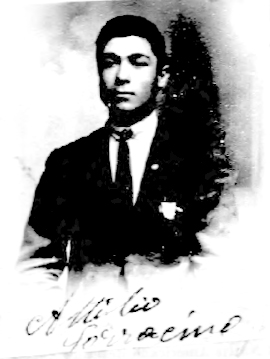
![]() |
| Attilio's 1924 passport photo. |
30 May 2017
Searching for the Missing Link in Your Family Tree
26 May 2017
How to Run Your Genealogy Research Like Clockwork
- Make an inventory of what you've collected. I keep a spreadsheet with columns for things like birth, death and marriage records, census forms, draft cards, etc. And I have one person on each line. This one document shows me what I have and what I need.
- Organize your documents into folders. Hopefully you've got some sort of a system going, but think about how you can improve it in a way that makes it crystal clear what is where.
- Annotate the documents you store in your family tree software. Your software probably lets you add notes to a file you've attached to an ancestor. Think about the family historian who will come after you. Annotate the documents in a way that would let anyone else find them the same way you did.
- Find the missing documents for one nuclear family. Use your inventory of documents you've collected, focus on one family, and try to locate the missing documents. Tie up those loose ends.
- Use a tool to analyze the flaws in your tree. Family Tree Analyzer is one such tool that will show you errors you didn't realize were there. How many can you resolve in one hour?
- Fill in the missing GEDCOM facts. When you do locate a census sheet for a family, do you add the residence, date, and occupation facts for each member of the household?
23 May 2017
Work in Batches to Strengthen Your Family Tree
Do you want to make your family tree accurate, reliable, and highly credible? There are many things you can do:
- Add descriptions to your images.
- Be consistent with addresses.
- Cite your sources accurately.
- Choose a style and stick with it.
I know it can seem overwhelming—especially if you started your tree long ago or you can only work on it now and then.
But if you divide and conquer your tasks, working in batches, you'll see real and valuable progress. If you gang-up your tasks, you'll save time and gain consistency.
Here's what I mean.
Add Descriptions to Images
Step through each image in whichever family tree software you use, focusing on one type of image at a time.
In Family Tree Maker, I can sort my images by type because I clicked a checkbox to categorize each one. Now I can go one-by-one through each census form image, for example, and include important information. I've chosen to note which lines a family is on, and everything you'd need to find the original image:
- town, county, state
- enumeration district, city ward, assembly district
- page number and image number if it's part of a set
- a URL on ancestry.com or familysearch.org.
![]() |
| Great annotations make your facts reproducible and verifiable. |
Be Consistent with Addresses
Your family tree software may help you validate a place name when you are typing. Take advantage of that feature if you have it.
Otherwise choose a style for entering place names, verify them on Google Maps, and stick with your style. I prefer to include the word County in my U.S. place names. I think it seems confusing (especially to non-Americans) to have something like "Monsey, Rockland, New York". That's why I consistently use this format: "Monsey, Rockland County, New York".
![]() |
| Entering the address shows me exactly where my great grandparents lived. |
Cite Your Sources
This will be blasphemy to some of you, but I do not like excessively long citations for the sources of my facts. I use a short format each time:
- 1930 U.S. Federal Census
- 1915 New York State Census
- New York Passenger Lists, 1820-1957
There isn't any question which collection I'm citing. Plus I put the full description and unique link on the image's notes.
No matter what format, do include your sources. It's absolutely key to the strength and reliability of your data.
Be Consistent in Everything
Do you always use the same date format? I prefer dd-Mon-year (24 Sep 1959) because you should understand it no matter where you're from.
Do you always capitalize last names? I don't, because I think you lose something with compound names like McCartney or deBlasio. But stay consistent.
Do you always spell out every word in an address? I do because I feel it leaves no room for misinterpretation.
For example, my mother was born at 260 East 151st Street, Bronx, New York. If your native language were not English, E. 151st St. would be more challenging than East 151st Street.
Do you have a preferred style for descriptions of immigration facts? That may seem like an awfully granular thing to call out, but I like to add specific information to these descriptions. Here's my format:
For each ship manifest I record the date the ship left as an Emigration fact (for a person's first voyage) or a Departure fact (for subsequent voyages). In the description I follow this format:
"Left for [destination city] on the [ship name]."
Then I record the date the ship reaches port as an Immigration fact (for a person's first voyage) or an Arrival fact (for subsequent voyages). In that description field I follow this format:
"Arrived [with which relatives] to join [which relative] at [address], leaving his [relative] in [hometown]."
Now think about your family tree. Where do you feel your data needs the most care? Is it your sources? Images? Particular facts?
Pick one and dive in. Work your way through as many people as you can in one sitting to ensure absolute consistency. Make notes about the style decisions you've made so you can stick to them.
By picking one type of task and working hard to plow through it all, you will see overall improvement in your tree.
That accomplishment should inspire you to pick your next subject and get busy strengthening your family tree. Then you'll be ready to grow your family tree bigger and better.
19 May 2017
5 Steps to Grow Your Italian Family Tree
![]() |
| This multi-generation chart is the tip of the iceberg. |
14 May 2017
How I Gained 2 More Generations in 1 Day
![]() |
| Maria Rosa Caruso, my great grandmother |
![]() |
| Maria Rosa's birth record. |
![]() |
| Key facts from an Italian marriage record. |
11 May 2017
6 Key Genealogy Facts on a Ship Manifest
![]() |
| Ellis Island, December 2017 |
![]() |
| Not a nuclear family, but 4 out of 5 of these men are mine! |
- Ship name (you can look for a photo of the ship)
- Departure date and port city
- Last name—a maiden name for many women

- Given name
- Age
- Gender
- Marital status
- Occupation
- Ability to read and write
- Nationality
- Race or people (e.g., Italian)
- Last residence (country and town)

- Name and location of nearest relative left behind

- Destination state and town
![]() |
| And they were all going to the same place! |
- Arrival date and port city
- Whether they have a ticket to their final destination
- Who paid for their passage
- How much money they are carrying
- If and when/where they were in the U.S. before

- Person they are joining here, often including the name and address of a relative

- Place of birth (country and town)

- A bunch of sure-fire extreme vetting questions, including (these are reworded):
- Are-you-a-deadbeat type questions, such as were you in prison, an almshouse, or supported by charity?
- Are you a polygamist?
- Are you an anarchist?
- Are you coming here because of a job offer?
- Condition of mental and physical health
- Are you deformed or crippled?
- Height, complexion, hair and eye color
- Identifying marks (including scars)
08 May 2017
Why You Need Your Ancestor's Draft Registration Cards
![]() |
| This tells me where his father lives in Japan. |
- full name and current address
- age and date of birth
- race:
- White
- Negro
- Oriental
- (American) Indian
- citizenship status
- place of birth
- occupation, employer and address of employment
- list of dependents including parent, wife, and sibling or children under 12
- marital status
- name and address of nearest relative (could be in another country)
- military service
- exemption from draft
- your ancestor's signature
- physical characteristics:
- height: tall, medium or short
- build: slender, medium or stout
- hair and eye color
- "Has person lost arm, leg, hand, foot, or both eyes, or is he otherwise disabled (specify)?"
- date the information was collected
- location of the draft board
![]() |
| Front side of a World War II draft registration card |
- full name and current address
- mailing address
- telephone number (if they had a telephone)
- age and date of birth
- place of birth including county (if within the U.S.) or country
- name and address of someone (usually a relative) who will always know where to find you
- employer's name and address
- place of employment or business
- your ancestor's signature
- physical characteristics:
- race: White, Negro, Oriental, (American) Indian, or Fillipino
- height
- weight
- hair and eye color
- type of complexion: sallow, light, ruddy, dark, freckled, light brown, dark brown, black
- Other obvious physical characteristics that will aid in identification"
- date the information was collected
- location of the draft board
05 May 2017
27 Key Facts to Extract from a Death Certificate
![]() |
| My grandfather's death certificate. |
| 1925 Bronx, NY | 1940 Bronx, NY | 1970 Warren, OH | 1992 Bronx, NY |
|---|---|---|---|
| Full name, sex and age | Full name, sex and age | Full name, sex and age | Full name, sex and age |
| Race | Race | Race | |
| Place of death and characterization of place (e.g., hospital, hotel) | Place of death and if it’s a hospital or institution | Place of death and if it’s a hospital or institution | Place of death; if in a hospital, date of admission |
| Date of death | Date of death | Date of death | Date of death |
| Time of death | Time of death | ||
| Attending physician and dates tending to the deceased | Attending physician and dates tending to the deceased | Attending physician and dates tending to the deceased | Attending physician and dates tending to the deceased |
| Primary and secondary cause of death | Primary and secondary cause of death | Primary and secondary cause of death | |
| Last residence | Last residence | Last residence | Last residence |
| Marital status | Marital status | Marital status | Marital status |
| Name of surviving spouse | Name of surviving spouse (maiden name if wife) | Name of surviving spouse (maiden name if wife) | |
| Date of birth | Date of birth | Date of birth | Date of birth |
| Social Security Number | Social Security Number | ||
| Occupation | Occupation | Occupation | Occupation |
| Whether served in armed forces | Whether served in armed forces | ||
| Date last worked at occupation | |||
| Birthplace | Birthplace | Birthplace | Birthplace |
| Citizen of what country | |||
| How long in U.S. if foreign born | How long in U.S. if foreign born | ||
| How long resident in City of New York | How long resident in City of New York | ||
| Level of education | |||
| Parents' names | Parents' names | Parents' names | Parents' names |
| Parents’ birthplaces | Parents’ birthplaces | ||
| Name of informant, relationship to deceased, and address | Name of informant, relationship to deceased, and address | Name of informant, relationship to deceased, and address | |
| Autopsy and laboratory tests dates | Autopsy | ||
| Name and location of cemetery | Name and location of cemetery | Name and location of cemetery | Name and location of cemetery |
| Date of burial | Date of burial or cremation | Date of burial or cremation | Date of burial or cremation |
| Funeral director's name and address | Funeral director's name and address | Funeral director's name and address | Funeral director's name and address |
02 May 2017
How to Squeeze Everything Out of the Census
![]() |
| The census format changes every time. Don't miss any important facts. |
- 1790 recorded only the head of family's name. Family members were tallied in columns of free white men 16 and up or under 16, free white women of any age, and slaves.
- 1800 and 1810 also named only the head of family. Other members of the household were tallied and broken down into males and females in five age groups. And slaves.
- 1820 added a few more columns to capture foreigners not naturalized, manufacturers, free colored people and slaves.
- 1830 added even more age ranges.
- 1840 added columns for people working in seven different professions, for military pensioners, for those labelled deaf and dumb, blind and insane (white and colored persons separately), and for those attending different types of schools.
- 1850 Behold! We finally get to see the name of every person in the household, their color (white, black or mulatto), profession, place of birth, and if they were married or attended school within the year. The form also captured those over 20 who could not read and write, as well as those who were "deaf and dumb, blind, insane, idiotic, pauper or convict." Oh boy.
- 1860 no longer cared about the deaf, dumb and blind, but did care who was illiterate.
- 1870 More good news! This year added each person's birthplace, whether they had a foreign-born mother or father, and if they were eligible to vote.
- 1880 added "Relationship to head of household" and the place of birth of everyone's parents.
- 1890 was almost entirely lost, and it's heartbreaking to see all that was added. In denoting a person's race/color, it asked for two races I never heard of. It asked for marital status and whether you were married in the previous year, how many children a woman has had and how many were alive. It asked if you were born in the U.S., were naturalized or had declared your intention to become a citizen. It asked separately if you could read and if you could write, and which language you spoke. It asked about disease, afflictions, and whether you were a "prisoner, convict, homeless child, or pauper." Homeless child? They enumerated homeless children?
- 1900 added the street name and house number, number of years married, years of immigration and how long in the U.S., number of months unemployed, and if you owned or rented your home.
- 1910 included a column for Veteran of Civil War.
- 1920 got a bit intrusive. If you own your home, do you have a mortgage? And what is the mother tongue of your mother and father?
- 1930 was when the government got pushier. What is the value of your home or how much do you pay in rent? Do you own a radio? What was your age at first marriage? The form went into lots of occupation detail, asking your industry, whether you were unemployed or a veteran and of which war.
- 1940 added the highest grade of school completed, where you lived in 1935, whether you worked or were seeking work, and how much you earned.