13 March 2018

Climbing Up, Down and Across Your Family Tree

Following a Hunch

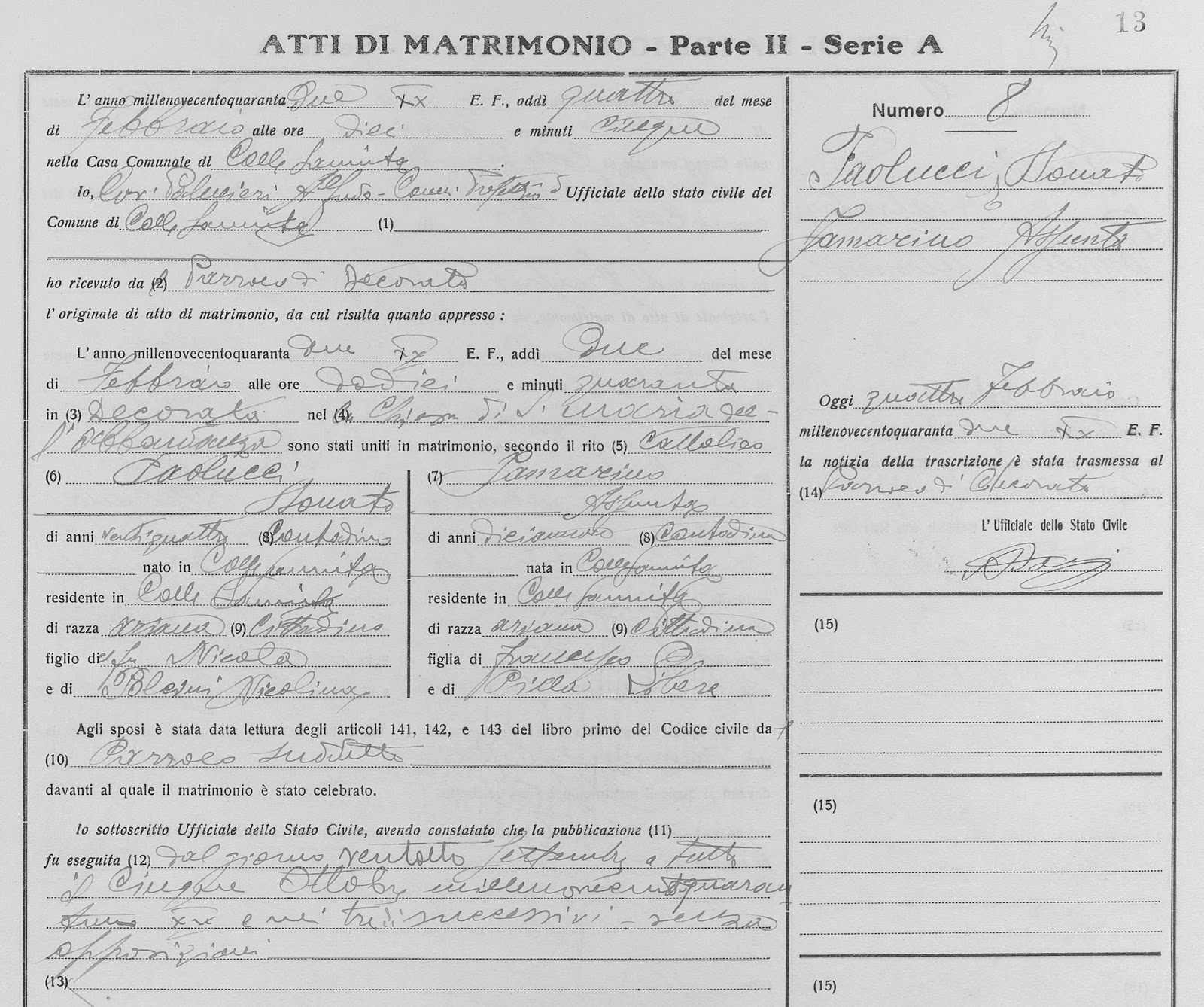
More facts about my great grandparents from my great aunt's marriage.
My great aunt's 1942 marriage.

Yesterday I was taking a looking at my grandfather's sister, Assunta Iamarino.

My oldest cousin from that family was born in 1948. The online marriage records from their hometown of Colle Sannita only go as far as 1942. It seemed unlikely that Assunta married any earlier than 1946, but I decided to take a look anyway.

What a huge payoff I found in 1942! Much to my surprise, Assunta and her husband Donato announced their intention to marry in September 1941. They married in February 1942. Their marriage documents confirmed their birth dates for me, too.

Finding More Clues

But 1942 wasn't finished surprising me. Paging through the marriage documents for that year, I saw two more brides named Iamarino. Checking my family tree, I realized they both belonged to me.

Two sets of marriage records filled out one family.
Filomena is 2 years older than her
Aunt Maria, and each married in 1942.

Maria Iamarino wasn't in my tree yet, but when I saw her parents' names, I knew exactly who she was. You see, her father Teofilo was the brother of my great grandfather Francesco. And her mother Filomena Pilla was the sister of my great grandmother Libera. Two brothers married two sisters and mushed together the branches of my family tree.

Then I found Filomena Iamarino's marriage. Filomena was born two years before Maria Iamarino, but she was Maria's niece! Her grandparents were Teofilo Iamarino and Filomena Pilla.

More mind-bending revelations.

Finally, 1942 gave me the marriage of Vincenzo Pilla and Teresina Piacquadio. They were already in my tree with no details. I knew their names only because a distant cousin, the nephew of Teresina Piacquadio, had given them to me. Now I have more facts and proof.

In one whirlwind session, leafing through one town's marriage records for one year, I found four marriages that matter to me.

Adding More Facts

This highlights the importance of finding more than your direct ancestors. Marriage records give you another data point for those ancestors and help fill in the gaps.

For example:
  • When I visited Assunta's children in Italy in 2005, they showed me the remains of Grandpa's house. It's on the property of one of Assunta's children. Grandpa left Italy in 1920.
  • In 1922 when Assunta was born, my great grandparents lived at Via Leandro Galganetti, 46. Google Street View shows that address as a pile of rubble now, far from Grandpa's house.
  • In 1942 when Assunta married, the family lived in Decorata. That's past Grandpa's house, and a good distance from Via Leandro Galganetti.
This expands what I know about my great grandfather Francesco. He came to America five times, leaving his family behind in Italy. He must have earned money and gone back home each time.

Now I can add to that profile that the family moved around within their town. They didn't stay in an ancestral home.

How much will your family history benefit from looking in all directions for relatives?

Don't stay only on the straight and narrow path. Each data point you find paints a richer portrait of your ancestors.

09 March 2018

4 Ways to Make Big Genealogy Progress When You Have Little Time

You've seen the memes. Genealogists would rather spend every moment working on their family trees than, say, eating, sleeping or dealing with people.

Got a little time? You can make real genealogy progress.
It doesn't take a ton of time to
make real genealogy progress.

Do you have the luxury of 100% free time? I don't either!

Don't worry. You can still make significant progress on your family research in short bursts of time.

Have about an hour after the dinner table is cleared? That'll do. Have some free time in the late afternoon before the family gets home? That's great! Are you an early riser? It's genealogy time!

Arm yourself with a list of tasks and a progress chart, and a small window of time can yield big genealogy progress. Here are some examples.

1. Choose a Specific Ancestor from your Grandparent Chart

Last night I was too exhausted to spend much time on genealogy. So I chose a specific ancestor from my "grandparent chart".

The chart shows me exactly which direct-line ancestors I've identified, and which ones I haven't. (See "How to Visualize Your Ancestor-Finding Progress".)

I chose one ancestor from the chart whose parents were missing. I found him in my tree to see what I knew about him. Then I examined his children's marriage records to see if they contained the names of their grandparents.

In the short amount of time I had (before I fell asleep at the keyboard), I added a few marriage document images to my tree. I can pick up where I left off when I have another chunk of time.

2. Improve as Many Source Citations as You Can

I have a few items on my Task List in Family Tree Maker that involve making my tree better. One task is to replace some of my weaker sources with strong ones.

For example, I received some relatives' information from a distant cousin. That's not very scientific. I'm happy to have the information, but I need to verify it with proof. (See "Trade Up to Better Family History Sources".)

So, when I have some time, I can go to these people in my tree and do the legwork. I can replace the "a cousin told me" source citation with more concrete facts and documents. That's a great use of time.

3. Enhance Your Tree's Document Images with Facts and URLs

Ever since I discovered this trick, it's been a must-do task for me. Before I attach a downloaded document image (vital record, census sheet, ship manifest, etc.) to my family tree, I add facts to the image itself.

You can add a descriptive title and comments to an image's properties. Many or all the facts will be pulled into your family tree file. (See "How to Increase the Value of Your Family Tree Images".)

Each time I have a new document to add to my tree, I edit its properties. I include a descriptive title, the name of its source and the URL it came from. Once I add it to my family tree, all I need to edit there is the date field and the category.

4. Create or Update Your List of All Gathered Documents

I'm a strong believer in keeping a spreadsheet inventory of my found documents. My document tracker contains more than 1,500 names of people in my tree, and each document I've found for them. (See "Track Your Genealogy Finds and Your Searches".)

When I have some time, I can choose someone in my tree, like my grandfather. I can see exactly which documents I have for him, and which are missing. In his case, I have his:
  • 1902 birth certificate
  • 1920 ship manifest
  • 1927 naturalization papers
  • 1930 and 1940 census
  • 1992 death certificate
There are only three important documents I would like to find for him:
  • His 1928 marriage to my grandmother
  • His 1959 marriage to my step-grandmother (I do have a record of their marriage license)
  • His 1958-or-so trip back to Italy—his one and only trip home since arriving in New York in 1920.
My document tracker makes it very easy to see what I can search for when I have some time.

Don't worry about not having countless hours to spend working on your family tree.

By spending a little time on your family tree more frequently, you will see true progress. You'll feel a sense of accomplishment. And you'll know your family tree—your legacy—is better and stronger than it was yesterday.

06 March 2018

How One Man's In-Laws Led to My Own Birth

It began with a 1900 ship manifest showing my relative, Giuseppe Caruso, on line one. I found this record very early in my family history research.

This ship manifest has a lot more to offer than my great uncle.
My second great uncle and another man had the same brother-in-law. Hmmm.

Giuseppe was my great grandmother's brother. I was looking for evidence that would lead to her ship manifest. This was a solid lead. It confirmed two facts: Giuseppe came from the town of Pescolamazza, Italy, and he was going to Elmira, New York. Those facts we enough to make me feel I had the right Giuseppe Caruso.

Before I filed the document away, I noticed the passenger on line two. Nicola Capozza was also from Pescolamazza. He was also going to Elmira, New York. But here's the curious part. Both Giuseppe and Nicola said they were joining their brother-in-law Michele Castelluzzo.

That's intriguing. I didn't know who Nicola Capozza was, but he and my great grandmother's brother shared a brother-in-law.

Skip ahead several years. I ordered the marriage certificate for my great grandparents from the state of Ohio. At that point I didn't know the maiden name of Maria Rosa's mother. This marriage certificate could be just what I needed!

My great grandparents' marriage certificate has a big clue for me.
What could I learn from the witnesses to my great grandparents' marriage?

If you've been dabbling in genealogy a while, you know how often the clue you need the most is the one that's missing. That's the case with this marriage certificate.

My great grandfather's parents' names are there. But I knew their names already. For the parents of the bride, it says "Francesco de Benevento" for her father. Well, her name is Caruso, and they were from the province of Benevento, so someone mistakenly wrote "Francesco from Benevento". No harm done. It's her mother's name that's the problem. All it says is Maria Luigia. No last name!

Still fuming, I turned my attention to the back of the marriage certificate. The witnesses to my great grandparents' wedding were Nicola Cappocci and Nicoletta Cappocci. I figured they were a married couple who knew my family. I wanted to know more about them.

There was a chance Cappocci was a misspelling since these were not signatures. Several wild-card searches later, I determined Nicola Cappocci was Nicola Capozza who shared a brother-in-law with my second great uncle, Giuseppe Caruso.

I found Nicola and his wife Nicoletta in the 1905 New York census. They were living with Giuseppe Caruso and his family. Then I found a 1909 ship manifest with Nicola coming to Susquehanna, Pennsylvania. Giuseppe Caruso lived there at the time. But Nicola's wife Nicoletta was back in Pescolamazza.

Next I found Pescolamazza birth records for Nicola Capozza and Nicoletta Martino on the Antenati website. But I hadn't tied Nicola and Giuseppe to that shared that brother-in-law.

The connection—not surprisingly—came from all the intermarrying of families in small Italian towns in the those times.

Capozza was the key.

The Capozza family was the key to a puzzle.
That the Capozza siblings' mother was also a Caruso is making my head spin.

Nicola Capozza's sister Marianna married my Giuseppe Caruso. So Nicola and Giuseppe, travelling together in 1900, were brothers-in-law. There were eight Capozza siblings. One of the girls, Caterina Capozza, married—wait for it—Michele Castelluzzo.

Michele came to America around 1891 and lived in Elmira, New York. There was plenty of railroad work, so Michele sent for his brothers-in-law. His wife's brother Nicola came to work. His wife's sister Marianna's husband Giuseppe Caruso came to work.

Giuseppe Caruso brought over most of his siblings. It's a safe bet that Giuseppe met my great grandfather, Pasquale Iamarino, working there in the Elmira railyard. He liked Pasquale enough to suggest that he marry Maria Rosa Caruso, who was still in Italy.

In July 1906 Maria Rosa came to join her brother in Elmira. Four months later, she married Pasquale Iamarino.

Every piece of evidence adds to the rich tapestry of our ancestors' lives. When I first saw that name of the shared brother-in-law, I didn't know he was significant. But if Michele Castelluzzo hadn't gone to work for the railroad in Elmira, New York, my great grandparents would never have married.

In fact, if Giuseppe Caruso hadn't married a Capozza, the Caruso family and the Iamarino family may never have met.

You have to marvel at how much luck and happenstance it take for you to be born.