14 August 2020

Get into a Groove to Fortify Your Family Tree

We each have the ability to be thorough, organized genealogists. But we don't always have the time.

I'm going to show you my multi-step process (accent on the multi). I follow this routine for each document image I add to my family tree.

First, let me explain what prompted me to write about how I get my genealogy groove on.

I found 4 notes in my genealogy task list that I wrote a long time ago. These notes list details about birth records I need to add to my family tree. The notes include the person's name, birth date and place, and the URL of the document image.

When I compared the notes to my tree, I realized I had added the facts to each person, but not the birth record images. I must have been in a hurry that day.

Now that I'm looking at those notes again, it's time to complete each task and delete those notes from my task list. Here's what I need to do for each one (deep breath):

  1. Go to the birth record stored on my computer. I have tons of Italian vital records downloaded from the Antenati website. I file them in nesting folders by province, town, and year/type of record.

    When you add to your task list, be specific so you can complete the task.
    When you add to your task list, be specific so you can complete the task.
  2. Crop the image and boost its contrast in Photoshop if needed. Export the cropped image to my "working" folder. This makes my in-progress images easy to find.

  3. Edit the properties of the image file to include a title and comments. The title might be "1835 birth record for [Full Name]". The comments might be: "From the Benevento State Archives: [full URL of original image]". These facts stay with the image and get pulled into my family tree program.

    Adding information to the image itself helps in your tree and when you share the file.
    Adding information to the image itself helps in your tree and when you share the file.
  4. Attach the image to the right person in Family Tree Maker and make it their profile image. (I don't have photos of my ancestors beyond most of my great grandparents.)

  5. Edit its properties to include the date on the document. Note: I don't put the date in the file's properties because it doesn't carry over into my software.
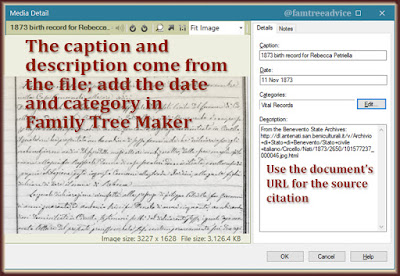
    Not only do the image's facts get pulled into your tree, you can use them to create a source citation.
    Not only do the image's facts get pulled into your tree, you can use them to create a source citation.
  6. Select a document category. (I save birth, marriage, and death records as "Vital Records".) This may be a Family Tree Maker thing only.

  7. Add each fact provided by the document to the person. That may include their full name, birth date, baptism date, place of birth, etc.

  8. Add a source citation to each of these facts. The URL I attached to the image is critical to the source citation.

  9. Add mention of this document to my Document tracker. I add a line to my spreadsheet for this person, if they aren't already in there. If I have an 1835 birth record image, I'll add this to the Birth column: "1835 (cert.)". The "(cert.)" tells me I have an image of the certificate. It isn't a fact pulled from somewhere else. It's the actual birth certificate.

  10. Move the image from my "working" folder to my "certificates" folder. It sits there until I do my weekly computer backup. After the Sunday morning backup, I move it to the right sub-folder of "certificates". I have so many certificates that I break them up into alphabetical groups.

OK, now I see why I didn't have time to do this when I found the records.

Despite all the steps, I'm happy to do each one. I know that when I'm done, I'm completely done, with no loose ends dangling. It's all a matter of getting into a groove, making each step a part of your routine, and enjoying the results.

Pressed for time? You can either:

  • Leave yourself a detailed note in your task list, or
  • Get that document as far as your "working" folder (step 2 or 3) and come back to it later.

Think of yourself as a genealogy manufacturing production line. You are cranking out a piece of perfection.

11 August 2020

Keep Track of Your Genealogy Theories and Tasks

I like to work from text-file task lists. I started doing this in my corporate job so I can easily re-prioritize my to-do list. If a task has a deadline, its line begins with the due date: AUG 11, AUG 25, etc. I keep those items in order so I never miss the deadlines.

This blog is about using business sensibilities and efficiencies in your genealogy research. So it makes perfect sense to use the task list idea in your family tree work.

There's no need for special software, although many of you may use Evernote or OneNote. You only need a text editor, like Notepad on a Windows computer or TextEdit on a Mac. I use Notepad++ because I can have a bunch of files open at once and include some HTML code when I need to.

Use your task list to keep track of:

  • Where you left off with a search for an ancestor.
  • Your theory about a particular ancestor and where you might find them.
  • A problem you're trying to solve, like an unreadable last name or conflicting birth dates.
  • Your progress on any of your annual genealogy goals.
  • Links to online pages that may be helpful to you, and a note about why.
  • Reference books you want to find or buy.

For each line item, it may help you to type last names in ALL CAPITAL LETTERS. Once you have several entries, you can organize them by type, or by branch of your family tree.

Keep a running, constantly updated list of what you're working on in your genealogy research.

Here's an example. I found an unusual 1809 death record for my 5th great grandfather, Vincenzo Liguori. I found it in the 1840 marriage documents of his grandson, my 3rd great grandfather. The problem is:

  • The document doesn't actually say he died in their hometown of Circello
  • It doesn't mention his parents or wife…only his son, my 4th great grandfather
  • It isn't included in the 1809 death records.

I need to find another version of the document in another set of marriage records. I'm missing the names of Vincenzo's grandchildren born before 1809. (Civil record keeping began in 1809 in my part of Southern Italy.) I need to search marriage records for anyone with the name Liguori.

I added this line to my task list:

  • Did Gregorio LIGUORI [Vincenzo's son] & Apollonia Grazia Caruso have a child before 1809? Search Circello marriages starting in 1825 for other Liguori children. (I'm up to 1841.)

The end of that line item tells me where I left off. That's critical to your task list.

Here's another example. My 5th great grandmother Francesca d'Andrea is a dead end. I don't know when she died or who her parents were. I think she came from Pesco Sannita because I see the name d'Andrea on lots of documents from that town. I started looking for people who might be her siblings.

I added this line to my task list:

  • Francesca d'ANDREA's parents may be Giuseppe and Rosa Salamone or Antonio and Vincenza Orlando. That's based on other d'Andrea death records. Search for supporting marriage documents. (Not started.)

Finally, I've been working on a branch of my family tree with the last name Consolazio from Santa Paolina. My closest Consolazio relative is my 2nd great grandmother. I've been renaming the town's vital records files to include the names on the documents. Then I'm trying to fit all the people named Consolazio into my family tree.

I added this to the task list:

  • I'm up to 1828 births reviewing CONSOLAZIO records.

Keep your task list open each time you sit down to work on your family tree. Consult it often. When you finish a task, add a note to the right person in your family tree, explaining how you learned this fact.

The notes in your task list are great reminders of what you've already done to solve a problem. Re-reading these notes may trigger that "aha!" moment and help you finally solve that puzzle.

07 August 2020

Solving 2 Problems to Find My 6th Great Grandparents

Don't stop your research too soon if the documents aren't crystal clear.

My last article convinced me to make a pair of 5th great grandparents my #1 genealogy priority. I needed to find their Italian death records so I could learn the names of 4 more of my 6th great grandparents.

As I began my search, I realized I had already located what might be both their death records in 1816.

The problem was, neither death certificate mentions the deceased's spouse. I needed to prove I had the right death records. He, 80-year-old Saverio Zullo, had a very common last name in their little town. She, 63-year-old Angela Montenigro, had a very uncommon last name. The town's vital records show there may have been only one Montenigro family in town when she was born. (Their age difference may mean Saverio had kids with his 1st wife.)

Before I set out to prove these were the right documents, I had another problem. The clerk in town at the time had awful handwriting. I cannot read the last names of my newfound 6th great grandmothers!

I kept track of my steps as I solved these 2 problems.

It isn't time to rejoice yet. These documents aren't definitively my 5th great grandparents.

Problem #1: Prove the 1816 Death Records Are for My Ancestors

Here is everything I did to determine if I had the right death records:

I searched the town's marriage records before and after 1816, looking for my 5th great grandparents' children.

  • In 1814, their son Saverio married, and his parents were still alive.
  • In 1815, their daughter Berardina married, and her parents were still alive.
  • In 1817, their son Carlo married, and his parents were dead!

Hurray! Only a genealogist is this happy to see that someone's parents have died.

The marriage records suggest Saverio and Angela died between 1815 and 1817. That supports the two 1816 death records as belonging to my 5th great grandparents.

There may be more proof, though. I searched more marriage records, hoping for a rewritten version of their death records. So far, I've gotten up to 1835 in this search. The supporting marriage documents for these years are mostly missing. But eventually I should find more complete marriage records for their grandchildren. Those records may include a rewritten version of Saverio Zullo's death record.

In the meantime, I was anxious about the other problem with the 1816 death records. What did those documents say?

I used several methods to figure out the bad handwriting in my 5th great grandparents' death records.

Problem #2: Figure Out My 6th Great Grandmothers' Last Names

Figuring out the last names of Saverio and Angela's mothers took a lot more work. Here's what I did:

  • I took my best guess on each letter in the last names. I compared the writing to the other words in the document, and in other documents written by the same clerk. It was clear that neither name had any ascending letters (b, d, f, t, etc.) or descending letters (also f, g, p, etc.). That helped me rule out many possible names.
  • I wrote down the possible letter combinations. I'm familiar with the common last names in this town from having examined so many vital records. These were not common names from the town.
  • I checked a few resources for the name variations I'd written down.
    • For Italian descendants, the Cognomix website shows where to find a last name in Italy today.
    • You can also search for a name on the Italian White Pages website.
    • I checked my digital copy of a book exploring the origins and variations of Italian last names. (Search online for name origins in your ancestral country.)
    • You can search for a last name on FamilySearch.org or Ancestry.com to see where people with that name come from.
  • I searched the town's records again for more documents with the 2 mysterious last names. I compared these to my original document. The clerks wrote the names a bit differently each time.
  • I searched for, and found, a sibling for my 5th great grandmother Angela Montenigro. This document gives me another look at my 6th great grandmother Berardina's last name.
  • The 1816 death records are missing an index. But the index for the year Angela's sister died gives me another look at Berardina's last name.

I took all these steps before making a decision. The evidence shows Saverio Zullo's mother, my 6th great grandmother, was Livia Carosa.

Angela Montenigro's mother, my other 6th great grandmother, was Berardina (sometimes Berarda):

  • Lavorana,
  • Laverono, or
  • Lavorino

It's still not clear which version is correct. But I did narrow it down. I'll continue to search for every Montenigro in town, and anyone with a last name that looks like Lavorana, Laverono, or Lavorino. For now, I'll choose which variation to use and add my 4 new 6th great grandparents to my family tree.

Soon I'll move on to my #2 genealogy priority. That is to find my 8 missing 6th great grandparents from the town of Circello, Italy. I'm so thankful for the Italian Antenati website and all the vital records!

Don't give up when a sloppy, indefinite document is all you have. There are so many tools you can use.