26 May 2020

Focus on Goals for a Better Family Tree

Your reasons for dabbling in genealogy can change over time.

My family tree has almost 24,000 people. You may think I'm swallowing up other people's family trees. Nope. Never ever would I do that.

Two years ago I wrote about how and when to cut a branch off your family tree. I cut my sister-in-law's entire family out of my tree because:
  • I didn't intend to work on them anymore.
  • People kept asking me about them—and they're not mine.
  • I had a new focus for my family tree.
Trimming that big branch off my family tree let me sharpen my genealogy focus.

Having a clear reason for doing genealogy makes it more rewarding.

You see, all my ancestors came from a 10-mile radius in Italy. They came from small towns with windy roads leading in and out. I soon found that the families intermarried. Almost everyone in these little towns had a connection to me.

I discovered this by reading the vital records from my grandfather's hometown. (They ranged from 1809 to 1860). When I began my research, I knew almost nothing about his family. His parents were Giovanni Leone and Mariangela Iammucci, and he had a brother Noah and a sister Eve. (That's pretty funny since his name was Adam.)

The only way to tell which Leone and Iammucci families were mine was to document everyone. In the end, I identified some of my grandfather's 4th great grandparents. And I had added 10,000 people to my family tree.

I spent 5 years researching the town (2008–2013). The whole time, I was thinking, "I can't wait to do my other grandfather's town!"

Fast-forward to 2017. The vital records I documented by viewing terrible-quality microfilm were online. Their quality was fantastic. And the documents went way beyond the 1860 limit of the microfilm I saw. My other ancestral towns were available, too. It's all free. (See "How to Use the Online Italian Genealogy Archives.")

The availability of these records sharpened my focus. My mission is to document all the connections among the people in my ancestral hometowns. My paternal grandparents were 3rd cousins. Now I have the vital records to back up that fact. My parents share DNA. Right now I'm exploring every branch of a DNA match's family tree because she matches both my parents. Each of her parents is my 6th cousin. Most of them come from my Iamarino hometown—my dad's side. Can I find a marriage in her family tree that draws in someone from my mom's ancestral hometowns? That's the goal.

Much like the little tree my husband pruned 2 years ago, my family tree is thriving. Cutting out the excess and putting energy into my priorities is key.

Trimming my family tree sharpened my focus and my goals.

Here are some focus-finding ideas to consider.

Goals Can Drive Your Research

Do you have specific goals for your genealogy research? One of my goals is to learn the names of all the families from my ancestral hometowns. These towns are my heart and soul. Learning their names, and finding their life events, gives me a joy I can't describe.

You Have More Cousins Than You Know

Are you interested in finding your ancestors' descendants? My 2nd great grandfather, Antonio Saviano, was my first ancestor to come to America. He had 4 children who lived to adulthood. Those 4 children had 21 children who lived to adulthood. That makes a ton of cousins, many of whom I've never met.

Imagine tracing the descendants of your 3rd or 4th great grandparents. Where will their descendants lead you?

DNA Unlocks Unknown Relationships

Do you want to figure out your relationship to your DNA matches? I've gotten in touch with cousins I never knew—or whose names I knew but I'd never met.

You need to make your tree as wide as possible to find the connection. Don't add your great grandparents to your tree and move on. Find their siblings. Who did they marry? What were the names of their children? Those families will tie you to your DNA matches.

I mentioned that both my DNA match's parents are my 6th cousins. That means we share 5th great grandparents. I needed to work all the 5th great aunts and uncles into my family tree. A wider tree will give you far more connections.

If you focus on your reasons for building your family tree, that focus will guide your process.

My focus is to connect everyone I can by using available Italian vital records. When it comes to my family in America, I have an in-law rule to keep me on track. Let's say my second cousin's husband is in my family tree. I'm not going to document him (the in-law) beyond his birth and marriage dates and the names of his parents. I'm not putting his siblings or his grandparents in my tree—even if I know their names. Unless my cousin asks me to research their spouse, they get cut off at their parents.

That's why I cut out my sister-in-law's 600-person branch. (I made them a separate tree.) It's why I removed the siblings and grandparents from more distant cousins' spouses. Focus.

Genealogy is a never-ending puzzle. An interesting, entertaining, educational hobby. Find your focus—your purpose—and you'll have a stronger family tree.

22 May 2020

Why Our Ancestors Marched Hours-Old Babies into Town

Were government regulations the reason so many infants died?

It was a surprise to see where my grandfather and two great grandfathers were born. The address is right there on their birth records. I knew the Iamarino family had land and several houses well outside of the center of town. Why were they born right near the church?

If they were modern-day Americans, they might move to a bigger, better house. But this was the late 1800s–early 1900s. They didn't move.

The solution to this mystery came from my cousin in Italy. Her sister still lives on the old Iamarino land, far from the center of town. My cousin told me that in the old days, when a woman knew she was going to give birth soon, she would go to a house closer to town. It may have been a house that the family kept for this purpose.

If you have to walk a newborn infant into town, the baby may as well be born close to town hall.

The woman needed to be close to a midwife when her time came. She couldn't wait hours and hours while someone rode a mule into town to fetch the midwife. This is why my ancestors were both born at Via Casale, 36, but their families lived a very, very long ride away.

The idea of a convenient place to give birth helped solve another mystery. I always wondered how new fathers in the old days could take a newborn baby to the town hall to record their birth. And then trot them over to the church to for baptism. When I had babies, they weren't supposed to go outside for at least a week. You took them home from the hospital and stayed put.

But what if the babies were born in a convenient house, close to the town hall and the church? The newborn's journey would be much easier. And less likely to lead to their death.

A father, midwife, or close relative had to report a birth to the mayor's office right away. My ancestors didn't report my great grandfather Giovanni's 1876 birth until 1898! They had to report it then so Giovanni could get married. This involved extra paperwork and probably a fine. Imagine my surprise when I stumbled upon his birth record in the year of his marriage.

I created an online map a while ago to plot many of my Bronx, New York, relatives based on their U.S. census records. It was interesting to see, and fun to imagine, so many relatives living within a few square blocks.

Now I'm wondering how many of my relatives were born in the same convenient birth houses. I can click through street addresses I've recorded in Family Tree Maker. I want to find houses where lots of babies were born.

I focused on the streets I knew were close to the center of town. One address, viewed in Google Street View, has its front door cemented shut. The nearby houses range from lovely to under renovation to flat-out ruins.

Family Tree Maker tells me I have recorded births and deaths of 24 people at this address. The dates range from 1877 to 1902, and they all have one thing in common. All 24 people have the last name Pozzuto.

I have a ton of people named Pozzuto in my family tree because I sought them out. This is a last name that has some connection to both of my parents. I located all the Pozzuto vital records in my downloaded Italian records collection. I worked most of them into my family tree. These 24 are not from the same nuclear family. Maybe this house was the preferred birthing place for an extended Pozzuto family.

Were all of your rural ancestors born at home, or did they have a special place in town?

What were the legal requirements for reporting a birth in your ancestral home? To find out, go to the Family Search Wiki. In the search field, enter "civil registration" along with your ancestors' country.

The wiki page for your country should begin with some historical background. Look for the year when the country began enforcing civil birth registration. Italy began civil record keeping in 1809 on Napoleon's order. (He was busy taking over the country at that time.) England began civil record keeping in July 1837. Before these dates, they may have recorded your ancestor's birth at the church. Being French is a good deal because their civil records start in 1792. If your ancestors are German, the beginning of record keeping depends on their exact area. But it was mandatory in all German states beginning in 1876.

I don't think you'll read anything about midwives' practices in the wiki. But as you discover birth records for your family members, check the document for an address. You may find that many members of an extended family have their very first address in common.

19 May 2020

Who Is This Man Who Isn't My Uncle?

Sometimes a rabbit hole is well worth the tumble.

I let a mistake guide my research this past Sunday. I must have been enjoying myself because I managed to forget it was my wedding anniversary. Again.

Here's what happened. I was randomly choosing people in my family tree and checking if they had good source citations. I want to bring all my source citations up to my new standards. I was working on my 2nd great uncle, Giuseppantonio Iamarino, who has a bunch of U.S. documents.

Then I noticed an error. He had arrived in America in 1903 and I had his 1920 census. But I'd also attached an immigration record from 1920—a few months after the census. That couldn't be him, could it?

I checked the facts on the ship manifest. The name and age were a match, and it mentioned his wife Libera back in his hometown. Aside from the date, the only fact that didn't fit my uncle was his destination: Girard, Ohio. My 2nd great uncle never left New York City.

If the document facts don't fit your person, what do you do?

Who was the Giuseppantonio Iamarino on this ship manifest? Was it a coincidence that Girard, Ohio, is where my great grandfather lived? And where my father was born?

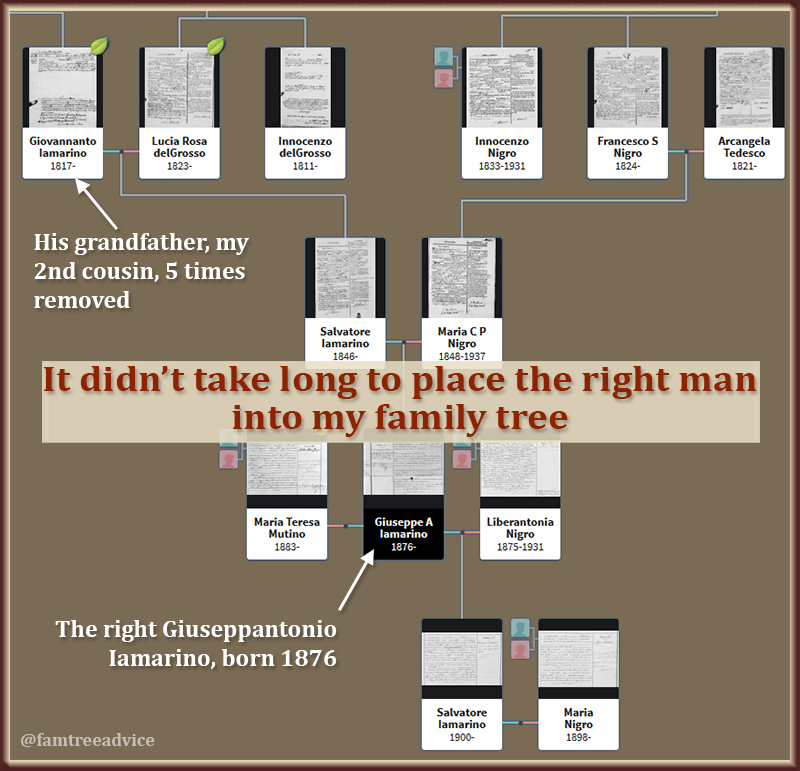
I turned to my collection vital records from Colle Sannita, Italy. I needed to find a Giuseppantonio Iamarino, born around 1876, who married a woman named Libera. There was only one good candidate, and he was not in my family tree.

Giuseppe Antonio Iamarino, born on 10 Jan 1876, was the son of Salvatore Iamarino and Costanza Nigro. Giuseppe's father was 30 years old at the time, so I jumped to the 1846 birth records.

I found Salvatore Iamarino's birth record. When I saw the names of his parents, I found they were already in my tree. His father, Giovannantonio Iamarino, is my 2nd cousin 5 times removed.

Anyone with that name definitely gets a spot in my family tree.

The man from the wrongly attached 1920 ship manifest was my 4th cousin 3 times removed. The ship manifest says Giuseppantonio was going to Girard, Ohio, to join his cousin with the last name Piccirillo. I eventually found out Piccirillo is the last name of Giuseppantonio's mother-in-law.

What else could I find? Which other documents and names could I add to firm up this branch of my family tree? Giuseppantonio's 1876 birth record had 2 big clues for me:
  • He married Liberantonia Nigro (the Libera from the ship manifest) on 12 Oct 1899 in Colle Sannita.
  • He married Maria Teresa Mutino on 8 August 1935 in Colle Sannita.
I'm very familiar with my Italian document collections. I knew that the 1899 marriage record would not be available. But, since Liberantonio died between 1920 and 1935, I could find her death record. It would tell me her age and her parents' names. Then I could find her birth record and her parents' marriage record.

I could find the 1935 marriage record for Giuseppantonio and Maria Teresa Mutino. That would tell me her parents' names so I could climb her family tree.

And then there were Giuseppantonio's parents, Salvatore and Concetta Nigro. Their marriage would not be in the document collection. But I found Concetta's 1937 death record. That gave me her age and parents' names. I discovered her full name was Maria Concetta Pasqualina Nigro. Her parents weren't in my tree yet, but her grandparents were.

I kept going. I searched for records for Concetta's grandparents, and I started seeing familiar names. Something strange was happening. Concetta (Salvatore Iamarino's wife) and Liberantonia (Giuseppantonio Iamarino's wife) were 1st cousins. Their fathers were brothers.

But wait. There's more! The father of these 2 brothers was Giuseppantonio Nigro. When his 1st wife died, he married Margherita Callara. They were in-laws. Giuseppantonio's daughter-in-law's mother was Margherita. And Margherita's son-in-law's father was Giuseppantonio.

This family tree branch just turned into a pretzel!

Just when I thought I'd make a terrible mistake, I realized what was going on in this family.

My little mission to find the man on a ship manifest added dozens of people to my family tree. They each opened more avenues to explore. Giuseppantonio's (from the ship manifest) 2nd wife had 2 husbands before him. Remember that this pre-1970s Italy. You remarried only after your spouse died.

She buried her 1906 husband and her 1909 husband before marrying Giuseppantonio Iamarino. She and her 2 previous husbands open up many more exploration routes. It's time to get all "Lewis and Clark" on them.

I believe I can take nearly anyone from these old vital records and find them a place in my family tree. I want to keep exploring these new avenues. Which personal milestone or national holiday will I forget this time?